Posts

Showing posts with the label Santo Niño de Cebu

The Canonical Coronation of the Señor Sto. Niño de Cebu - A Special Feature

Image
A painting depicting the Canonical Coronation of the image of Santo Niño de Cebu  the lone Christological image in the Philippines with such honor by far. Written and annotated by: Rev. Fr. Fray Ric Anthony Alcibar-Reyes, OSA Originally Published by: The Freeman, January 11, 2015 Blogger's note: As we are about to celebrate the 500th year of the arrival of Christianity in our country in 2021, I was already planning to do a series of blog posts leading to the much anticipated celebration in our country. To have certain excitement for such a celebration is inevitable for the mere fact that our present generation will experience this once in a lifetime event.  Santo Niño de Cebu wearing his Canonical Crown However, due to the harrowing effects of the spread of COVID-19 worldwide, all major events - religious and secular - were put to a halt and all the major sectors of our society are gravely affected with this pandemic. With this circumstance, it gave me a...
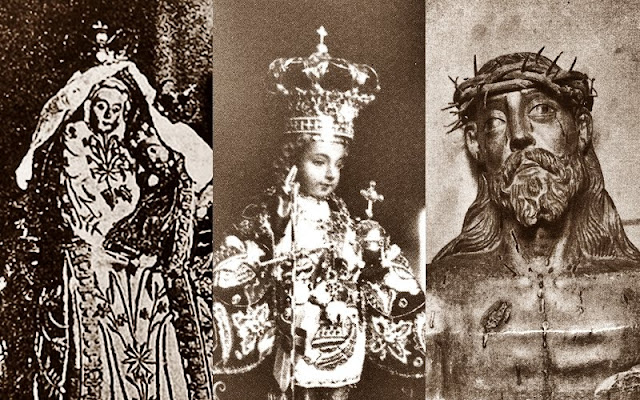
El Ecce Homo and Virgen dela Cotta de Cebu - The Unsung Gifts of Ferdinand Magellan

Image
The gifts of Ferdinand Magellan (From the left): Virgen de la Cotta, Santo Niño de Cebu, El Ecce Homo de Cebu In common Philippine history books, the majority of Filipinos would encounter that in 1521, after the Mass in Cebu, Portuguese explorer Ferdinand Magellan gave the newly baptized Raja Humabon and Hara Humaymay an image of the Child Jesus, which will later be known as the famous and miraculous Santo Niño de Cebu. However, little that the people know is that there were two more images that were given by Ferdinand Magellan to the newly baptized couple, the Ecce Homo and the Virgen de la Cotta of Cebu. Antonio Pigafetta, the chronicler of the voyage attested to this act of Magellan to the newly baptized ruling couple and their subjects. These two images were hidden for some time and later rediscovered separately and enjoyed much devotion for centuries until the Second World War came that signaled the abrupt obscurity of the devotions of these two important venerated images ...

Santo Niño de Cebu - The Eternal King of the Philippines

Image
Sto. Nino de Cebu The most revered image in the Philippines -  Santo Niño de Cebú is an image of the Child Jesus much venerated as miraculous by the majority of Filipino Catholics and revered as the symbol of the Catholic Faith in the country. The oldest Christian image in the Philippines, it was originally given in 1521 as a baptismal gift by Portuguese explorer Ferdinand Magellan to Hara Humamay, the chief consort of Rajah Humabon, along with a statue of the Virgin Mary, and a bust of depicting Christ as Ecce Homo. The image is one of the most celebrated in the country that is highlighted through the celebration of Sinulog Festival every Third Sunday of January, its Liturgical Feast and on Kaplag every April 28th, its Original and Traditional Feast, to commemorate the rediscovery of the image by Juan Camus. Miracles have recorded through his help that he continues to shower his devotees up to the present. Features of the Image The image measures approximatel...

Ang Mahal na Birhen: Mary in Philippine Life Today

Image
Inang Kalinis Linisan (La Inmaculada Conception Mary, Mother of  God Parish, Muntinlupa City To the people of God in the Philippines, especially the clergy, religious men and women, and members of mandated organizations Dearly Beloved The unavoidable conclusion of anyone contemplating the religious practices of the Philippines is that we Filipinos are indeed a religious people.  The thousands of churches and chapels all over the Islands, from the Batanes in the North to Jolo in the South, testify that Christianity has become a true part of Philippine life.  We consider ourselves the Christian country of Asia. When one tries to determine the characteristic of our Christian faith, one finds that our practice of religion has taken on a popular color and has a special sense of devotion that makes it specifically Filipino.  He finds that certain traits of Philippine Christianity transcend the boundaries of Catholicism and are found with equal prominence in othe...