Posts

Showing posts with the label Manila

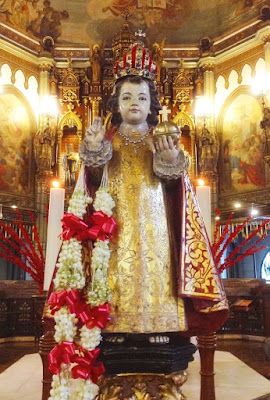
Santo Niño de Praga of Manila - The Miraculous King of Mendiola, Manila
Image
Santo Niño de Praga of Manila  In the famed Abbey of Our Lady of Montserrat, aside from the Virgin of Montserrat, there is another venerated image that also enjoy much devotion and veneration by the Benedictine monks, students and alumni of San Besa University and its sister schools and the faithful of Mendiola, Manila - the miraculous Santo Niño de Praga of Manila. The image of Santo Niño de Praga became one of the distict devotions within Manila's University belt and his devotees would flock the abbey to ask for his miraculous intercession. The image The venerable image of Santo Niño de Praga de Manila is wooden image of the Child Jesus done in de tallado style. The Niño's caoe and robe are painted in estofado style that gives an illusion that the image was wearing a set of embroidered vestment. The Prague Child of Manila was patterned from that of the original image in Prague in Czech Republic: The Child Jesus stands upright, his right hand is in gest...

The Mysterious yet Miraculous Twin Crosses of Tondo

Image
The Twin Crosses "Kambal na Krus" of Tondo, Manila Tondo, Manila, known as one of the most populated yet historically significant district in the Capitol. Tondo is also known as the home of the famed image of Señor Santo Niño de Tondo - the second oldest image of the Child Jesus in the country.  The Crosses The mysterious yet miraculous "Kambal na Krus" was more of log cut into half where the imprints of a Cross can be seen. One piece is a bit larger than the other, but both are adorned with burst of metal rays or rayos, and draped with embroidered cloth serving as capes of sorts.The trunks, which have darkened with age making the crosses less visible, flank a carved figure of crucified Christ.  Crispino Lacandaso with the "Kambal na Krus" The mysterious discovery On March 23, 1922, a young labourer named Crispino Lacandaso was chopping wood from a felled, hundred year-old sampalok (Tamarind) tree on an empty lot at 1885 Juan Luna S...

Imprints of A Holy and Glorious Past - The Surviving Patrons of Old Intramuros

Image
The old La Naval de Manila Procession in Intramuros years before the Second World War A depiction of Intramuros Whenever we pass the area of the Manila City Hall going to Quiapo-Tondo-Sampaloc area, we always see an imposing wall on the opposite side of the iconic City Hall - the famed centuries old walled city of Intramuros. The area of Intramuros (Which literally mean "Within the Walls") during the Spanish period was considered as Manila and the arrabals surrounding the walled city from Quiapo, Santa Ana, Santa Cruz, Sampaloc, Bagumbayan (now the Luneta area), Tondo, Binondo, Paco, Pandacan and Ermita are known as "Extramuros". Since its foundation in 1571 with the conquest of Miguel Lopez de Legazpi and its construction sometime later, Intramuros became one of the nerve centers of the Philippine Catholic Faith, next to Cebu, for it was chosen as the seat of Catholic Church in the country with the foundation of the Archdiocese of Manila from its parent ...

Nuestra Señora de Guia - The Oldest Existing Marian image in the Philippines

Image
Nuestra Senora de Guia The Image of Nuestra Señora de Guia (English:Our Lady of Guidance) is considered as the oldest Marian statue in the Philippines. There were different historical theories regarding the origin of this image, either from the Ferdinand Magellan expedition, Chinese traders, or apparently, the storied Bolinao Mission of Odoric of Pordenone, a Franciscan Missionary, of 1324 prior to the Magellan expedition. The wooden Black Madonna statue is locally venerated as patroness of navigators and travelers since the Spanish times, the image is enshrined at the Archdiocesan Shrine of Nuestra Señora de Guia, popularly known as the Ermita Church, in Ermita, Manila. Features of the Image Made of molave (Vitex cofassus) wood, the statue stands about 50 centimetres (20 in) and is characterized by dark skin with a long, light brown hair.  The image is depicted as the Immaculate Conception, she is dressed in both a manto and a stylized tapis, the traditional wraparo...